Temples
Reading a Greek Temple Facade
A practical route from platform to roofline, with each visible part tied to a documented architectural function.
AI-assisted editorial draft · human editor pending
Read the StoryMythology, architecture and visual culture
Explore Greek myths, recognize the details of classical architecture and discover how artists reinterpret the ancient world.
Mythological plots, characters and the different versions preserved by ancient writers and artists.
02TemplesFaçades, columns, pediments, steps and decorative systems explained through documented examples.
03ArtSculpture, painting, book illustration and contemporary ways of reimagining the ancient world.
Featured stories
Begin with a façade, an order, a surface or a modern image. Every story distinguishes documented evidence from interpretation.
A practical route from platform to roofline, with each visible part tied to a documented architectural function.
AI-assisted editorial draft · human editor pending
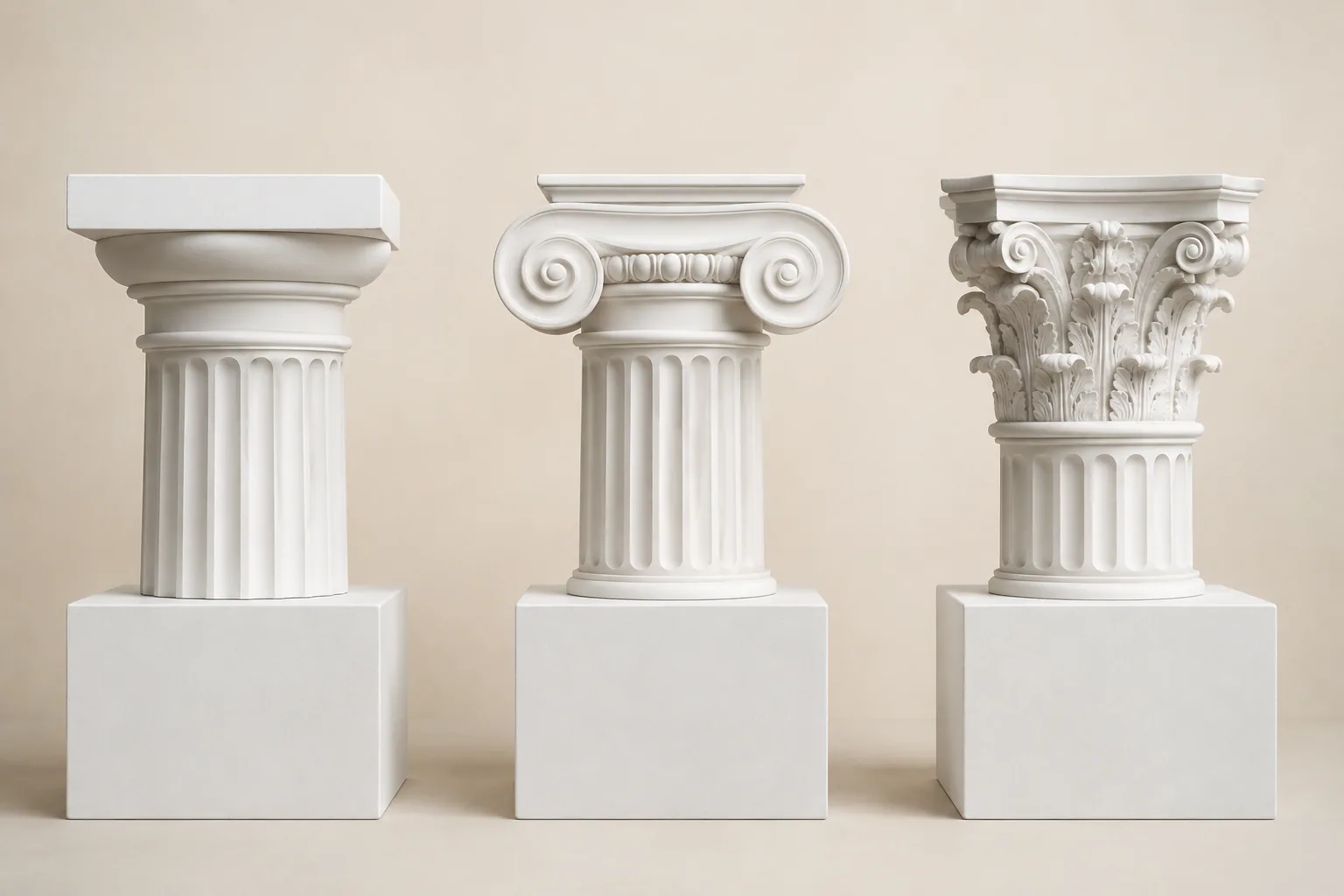
Read the StoryHow base, shaft, capital and entablature work together in the three best-known classical orders.
AI-assisted editorial draft · human editor pending
Read the StoryA source-led look at the thunderbolt as a divine weapon, an identifying attribute and a modern visual shorthand.
AI-assisted editorial draft · human editor pending
Read the StoryGreek myth was retold through poetry, performance, local tradition and art—not fixed in one authoritative volume.
AI-assisted editorial draft · human editor pending
Read the StoryLow viewpoints, repetition, contrast and empty space can make an invented building feel larger than the frame.
AI-assisted editorial draft · human editor pending
Read the StoryLook for an evidence trail, explicit uncertainty and captions that separate documented fabric from invention.
AI-assisted editorial draft · human editor pending
Read the StoryArchitecture at a glance
| Order | Recognizable Features | Documented Example | Further Reading |
|---|---|---|---|
| Doric | Fluted shaft without a separate base; cushion-like echinus and flat abacus; triglyph-and-metope frieze. | Temple of Apollo at Corinth, second quarter of the sixth century BCE.The Metropolitan Museum of Art | Visual introduction Source register |
| Ionic | Column base; paired volutes; horizontal architrave bands and often a continuous frieze. | Temple of Athena Nike on the Athenian Acropolis, late fifth century BCE.British Museum | Visual introduction Source register |
| Corinthian | Bell-shaped capital with acanthus leaves, spirals, palmettes and small corner volutes. | Temple of Zeus at Euromos, documented in Nicholas Revett’s measured drawing of 1764–65.British Museum | Visual introduction Source register |
This is a recognition guide, not a ranking or a replacement for an architectural record. Each example links to a museum source.
Reading the illustration
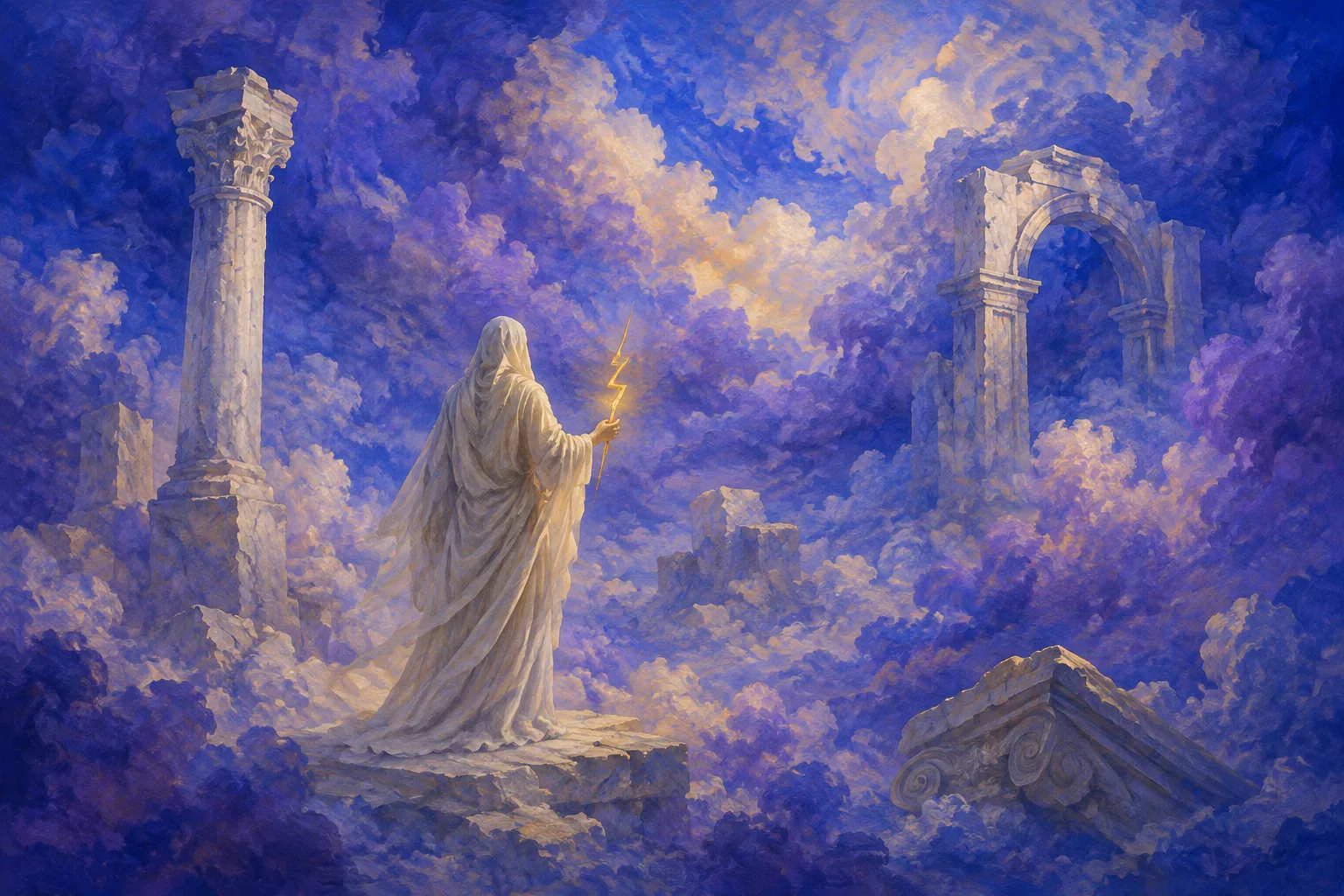
This illustrated reading separates details with documented architectural analogues from the figure, portal-like scale and storm lighting invented for contemporary visual storytelling.
Support and rhythm
Carry horizontal elements while establishing repeated intervals of solid and open space.
Transition
Mediate between shaft and load; their form is one clue to an architectural order.
Documented form
The triangular gable at a pitched roof end has ancient architectural parallels; the giant round opening in our hero does not.
Approach
Raise the building above its setting and turn arrival into a visible sequence; exact access must be checked against a specific site plan.
Contemporary invention
Creates a human-scale focal point in concept art; it is not evidence for a statue or cult image at a historical temple.
Composition
Balances repeated architectural masses around an axis and makes the invented scene feel ordered and monumental.
Artistic treatment
Violet clouds and gold radiance guide attention. They belong to the modern illustration, not to a reconstruction record.
How we research
Dates, materials and identifications are checked against museum, archaeological and academic sources.
Visible form is recorded before a stylistic label or cultural meaning is proposed.
Photographs, reconstructions, measured drawings and contemporary illustrations are labelled as different kinds of evidence.
Source scope is recorded with each article, and substantive changes belong in the edition record.
About & FAQ
Olympus Journal is an independent educational draft for readers who want to distinguish a named ancient account, a documented structure, a reconstruction and a contemporary interpretation.
Scope, authorship and responsibilityThe journal explains Greek myths through named sources, introduces ancient temple architecture and examines modern artistic interpretations of classical forms. It is an educational publication, not an archaeological database or reconstruction service.
Articles use documented buildings as examples, but the prominent images in this edition are original AI-assisted editorial illustrations. Every concept study is labelled and should not be treated as evidence for a named ancient building.
Greek myths circulated through poetry, drama, local traditions and visual art rather than a single canonical book. We identify the ancient author and passage for a particular version instead of blending separate accounts into one “original” story.
A reconstruction should name its site, evidence and uncertain elements. Our fantasy illustrations are explicitly captioned as contemporary concepts, with invented scale, lighting or structures identified in the accompanying text.
Visibility on this website does not grant a reuse licence. Review Sources & Image Credits and obtain permission from the verified publisher. External reference material remains subject to its own terms.
The Contact page will show a working email after the owner supplies and verifies it. Until then, [CONTACT_EMAIL] remains visible and no monitored inbox is claimed.