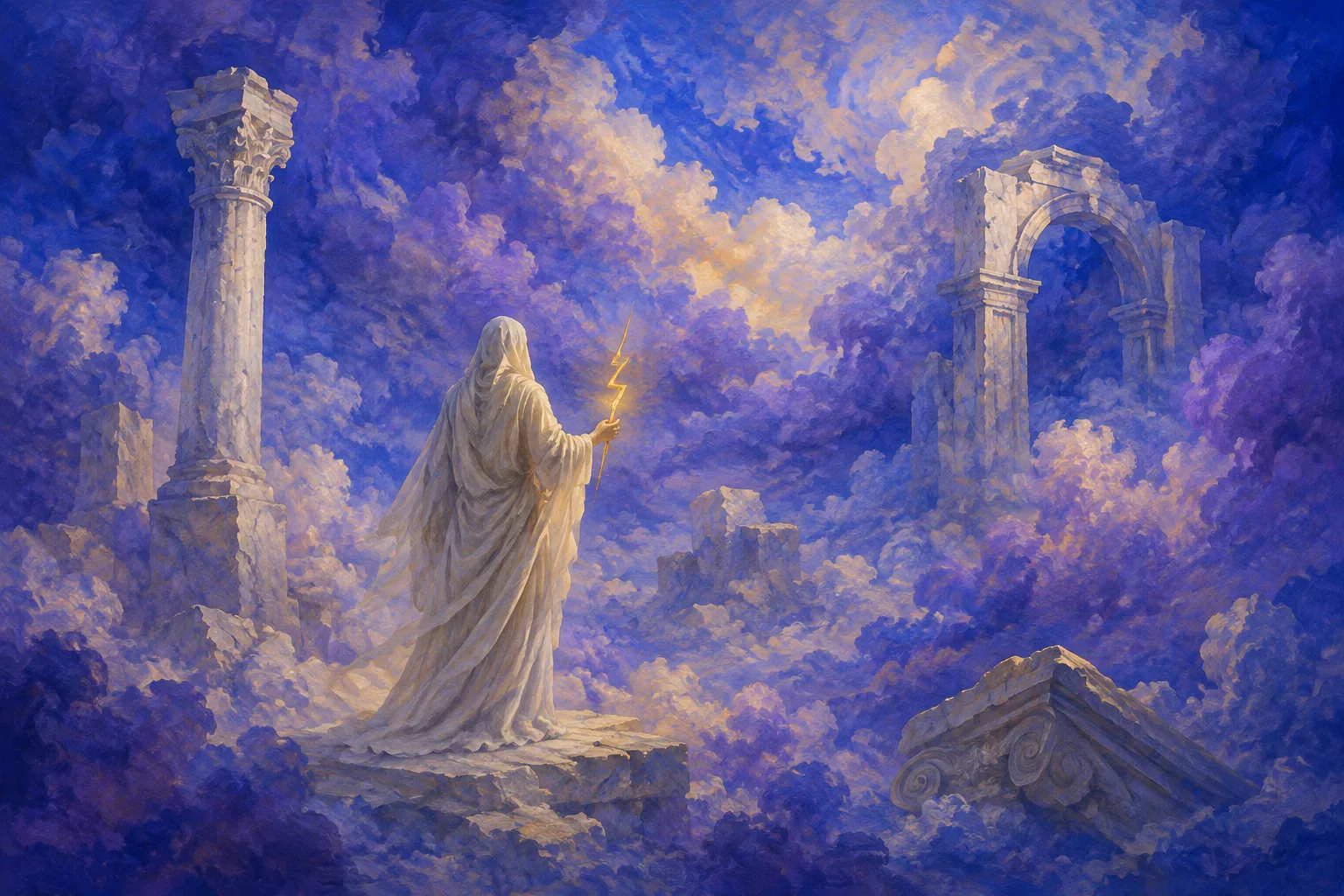
Polished images can make reconstruction and fantasy look equally authoritative. The difference lies less in realism than in method, documentation and the honesty of the caption.
A reconstruction has an evidence trail
A historical reconstruction should identify the site or object, the recorded remains, comparative evidence and the choices used to fill gaps. It should also allow a reader to find the underlying publication or catalogue.
The Met’s work on ancient color shows this principle clearly: technical examination supports specific proposals, while the presentation explains how evidence was interpreted. High production value alone is never the proof.
Historical does not always mean ancient
Greek Revival architecture belongs to a later historical moment. The British Museum describes its own nineteenth-century building as a modern institutional design using Greek architectural language. Calling it classical-inspired is accurate; calling it an ancient Greek temple would not be.
Date the image and the building separately. A recent photograph may show a nineteenth-century portico; a recent rendering may propose a fifth-century temple. Clear labels prevent those layers from collapsing.
Fantasy is visible through departure
Impossible scale, floating fragments, circular portals, storm-lit interiors and mixed ornamental systems are common signals of imaginative design. They can sit beside accurately observed columns or materials. The mixture is the point.
Recognition should lead to a two-column note: documented references on one side, inventions on the other. This respects both history and the artist’s authorship.
Use a four-part caption check
Ask: who made the image, when, what does it depict, and what is its status? Useful status terms include photograph, measured drawing, evidence-based reconstruction, hypothetical reconstruction and contemporary concept illustration.
If a source or licence cannot be verified, do not imply that the image is free to reuse. This journal’s original illustrations are identified as such; external sources are linked for reading and remain under their publishers’ terms.
Reading takeaway
Trust a reconstruction when its evidence and uncertainty are traceable—not merely when it looks convincing.
Sources and scope
These references support the factual frame of this article. They do not endorse its contemporary illustrations or editorial interpretation.
- The Metropolitan Museum of ArtArchitecture in Ancient Greece
Temple plans, materials, painted decoration and the identifying relationships of the classical orders.
- The Metropolitan Museum of ArtNew Research on the Color of Greek Sculpture
Scientific examination of surviving pigment and the evidence-led reconstruction of ancient color.
- British MuseumGreek Revival architecture: simplicity and splendour
Evidence for later reuse of Greek architectural language in a nineteenth-century museum.