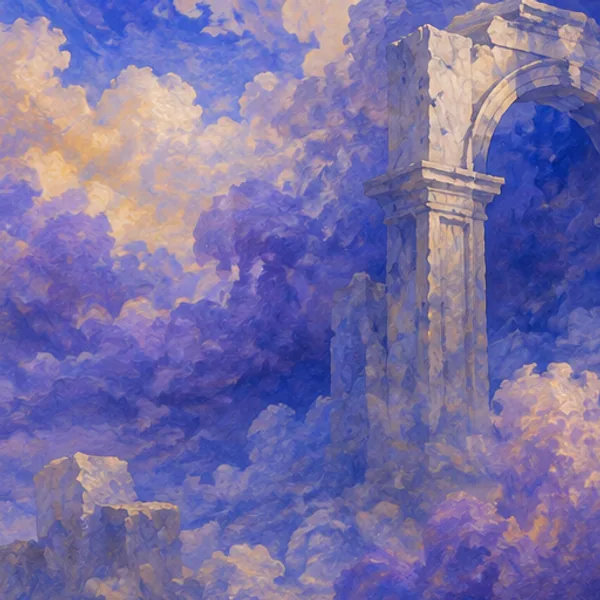
Monumentality is an effect as much as a measurement. A designer can make a compact image feel vast by controlling viewpoint, repetition, light and the size of familiar details.
Place the eye below the structure
A low viewpoint makes columns rise sharply and hides the upper surfaces of steps. Converging edges suggest that the architecture continues beyond the viewer’s reach. A tiny figure or doorway can provide a scale reference, but that reference can also be manipulated.
When evaluating concept art, ask whether the scene offers consistent human scale. If stairs, doors and columns imply conflicting dimensions, the contradiction may be deliberate spectacle rather than a buildable proposal.
Use repetition to imply continuation
A row of columns creates predictable intervals. When the row leaves the frame, the mind completes it. Repetition also produces ceremonial rhythm, directing attention to a break at the center.
Classical orders are especially effective because their parts are recognizable. Yet borrowed rhythm does not prove a historical model. The British Museum’s Greek Revival building shows how classical language can be reused in a later, documented context.
Make light organize the hierarchy
A bright threshold against a darker surround becomes the destination. Rim light separates a silhouette; reflected color links distant surfaces. These decisions tell the viewer where to look before narrative text supplies a reason.
Our illustration uses violet cloud shadow and gold radiance to stage an impossible space. The palette belongs to modern visual storytelling. A reconstruction would need evidence for openings, orientation, surface and illumination.
Leave room for the imagined visitor
Empty stairs and broad forecourts give the viewer a place to project movement. Sparse compositions can feel more monumental than crowded ones because each architectural interval is legible.
This is a design observation, not a universal claim about ancient experience. Historical questions about procession or access must return to the particular site and its evidence.
Reading takeaway
Monumentality can be composed with viewpoint, rhythm, contrast and scale cues; none of those choices alone makes an image historical evidence.
Sources and scope
These references support the factual frame of this article. They do not endorse its contemporary illustrations or editorial interpretation.
- The Metropolitan Museum of ArtArchitecture in Ancient Greece
Temple plans, materials, painted decoration and the identifying relationships of the classical orders.
- British MuseumGreek Revival architecture: simplicity and splendour
Evidence for later reuse of Greek architectural language in a nineteenth-century museum.